
It’s a pattern that is repeated thousands of times – and nobody talks about it.
After months of learning German, I’ve finally made it: I’ve passed the B2 exam. A milestone. A reason to be happy. But then something paradoxical happens: “Nothing”.
International nursing staff are waiting. Weeks turn into months. Visas are processed, recognitions are processed, appointments are postponed. And while the bureaucracy takes its course, the inevitable happens: The painstakingly acquired German language skills fade. Without practice, without application, without feedback. What was fluent yesterday becomes halting today, uncertain tomorrow.
At the same time, the inner ordeal begins. The farewell to family and home draws closer. The uncertainty grows. “What can I really expect in Germany? Is my German even good enough? Will I meet the requirements?” At this point, most people still think: B2 is enough. I can work with that. I can cope with that.
But the truth is different – and German hospitals have known this for a long time.
You have experienced it. Not once, not twice, but time and time again: international nursing staff arrive – motivated, qualified, having passed the B2 exam – and still fail when faced with reality. The medical terminology, the documentation requirements, the rapid colloquial language in the team, the unwritten rules of German working culture: none of this is in the textbook. B2 is a foundation – but not a finished house.
The result? “A vicious circle of excessive demands”.
The new nurse is thrown in at the deep end, struggling with language and systems. The ward manager senses the frustration – once again, she knows what an additional burden the team is now facing. Training under time pressure. Explanations that cost time. Misunderstandings that can lead to mistakes. And in the end, the bitter question: “Why didn’t we see this coming?”
But there is hope. Recruitment continues. You wait for the next nurse – in the silent hope that “this one” will arrive better prepared, that “this one” will finally meet expectations. But why should she? If nothing changes in the system?
There is another way!
The shortage of skilled workers will not go away. According to the Federal Statistical Office, there could be a shortage of around 280,000 nursing staff in Germany by 2049. International recruitment is no longer a temporary solution – it is part of the future. But for it to work, we need to stop ignoring the crucial phase: the months between B2 and entry.1,2
The Federal Office for Migration and Refugees (BAMF) points out that continuous language practice is crucial for sustainable integration, especially in a professional context (BAMF – Studies on linguistic integration in the labor market).3
What if international nursing professionals arrived not just with B2, but with real skills? Linguistically deepened. Professionally oriented. Interculturally prepared. Mentally strengthened. Ready for everyday nursing care in Germany – not in theory, but in practice.
What if ward managers no longer sighed in frustration, but breathed a sigh of relief?
The solution does not lie in more recruitment. It lies in better preparation.
In this article, I will show you why the phase between the B2 exam and entry is the most underestimated success factor in international nursing recruitment – and how you can use it strategically.
Change of perspective: From waiting time to preparation time!
This presents a strategic opportunity for hospitals and recruiting agencies. The time between completing B2 and entering Germany can be used as: Qualification phase, integration preparation, retention phase and professional orientation.
International experience shows that preparatory programs significantly improve integration. The World Health Organization (WHO) emphasizes that structured preparatory programmes for international healthcare professionals accelerate integration and reduce drop-out rates
(WHO – Health Workforce Integration Guidelines).4
Four building blocks of an effective bridging phase have proven themselves in my many years of experience as an expert in German as a foreign language, certified intercultural trainer for the healthcare sector, intercultural mediator and certified coach:
Language consolidation beyond B2. This is because professional language and colloquial language in Germany is more complex than examination German.
Medical communication, documentation language, conversations with patients and
everyday language in Germany should therefore be practiced before entering the country.
Professional preparation for German work processes. This is because international nursing staff have specialist knowledge – but not automatically knowledge of the system.
According to the OECD, it is precisely this system knowledge that is a decisive integration factor in the healthcare sector. Professional preparation for documentation standards, care processes in Germany, quality management, patient safety and the understanding of roles in multi-professional teams should therefore be part of successful integration at an early stage.
Intercultural and social orientation. Integration rarely fails due to specialist knowledge – more often due to expectations and communication.
Important topics are therefore: work culture in Germany, communication within the team, personal responsibility in day-to-day care, dealing with hierarchies and feedback culture. The BAMF also describes intercultural preparation as a key component of sustainable labor market integration.
Mental stabilization and motivation. Unstructured waiting time can lead to: Uncertainty, demotivation, loss of commitment and doubts about the project. And don’t underestimate the fact that international nursing professionals are often leaving family, friends and their home country behind for the first time.
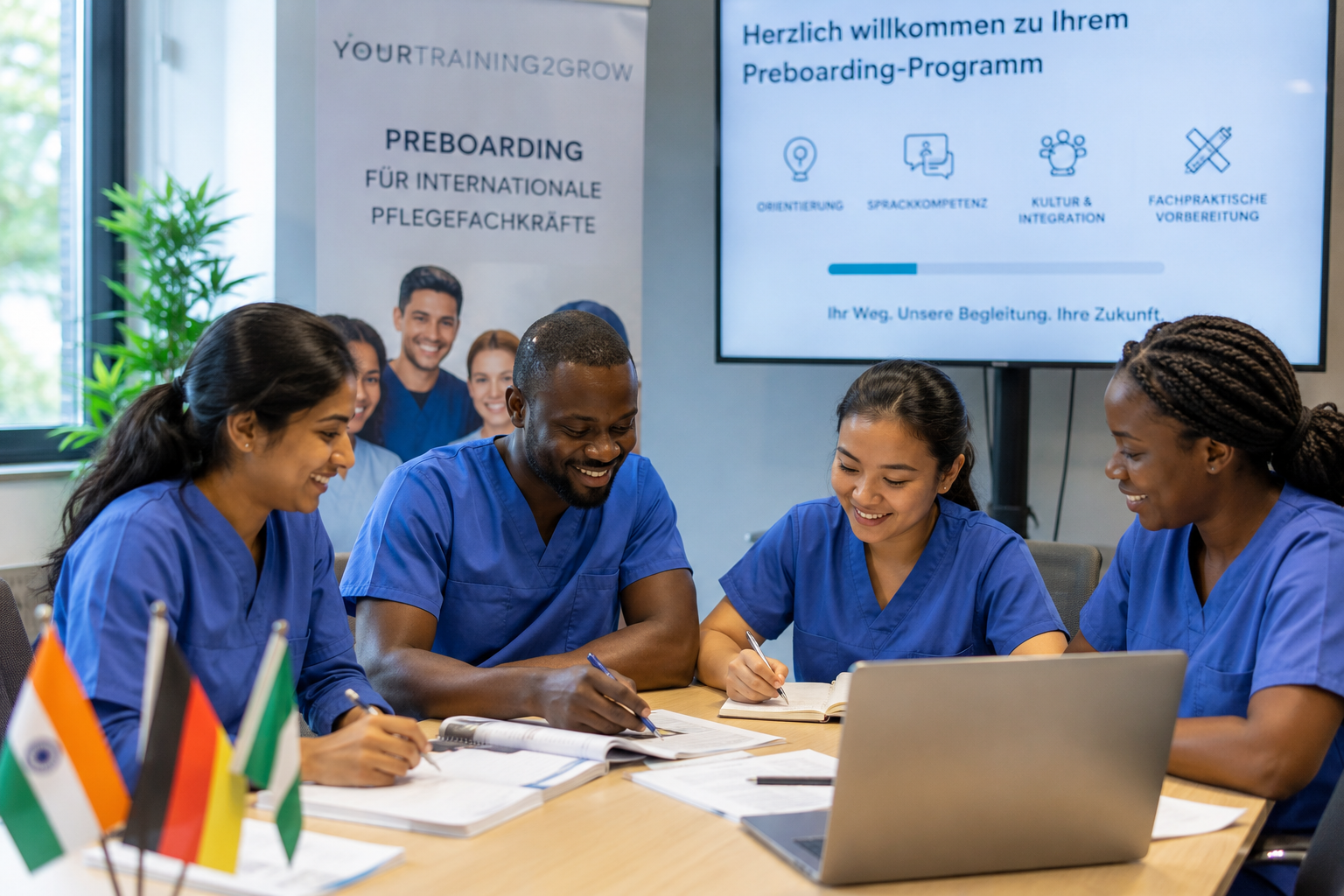
Structured programs, such as our pre-boarding system, counteract uncertainties and fears. By contrast, they create orientation, a sense of progress, trust and loyalty to the employer.
Recruiting agencies and hospitals regularly report that prepared specialists are ready for work more quickly and stay longer. The added value for hospitals and recruiting agencies is obvious: shorter induction time, fewer integration problems, higher employee retention, faster availability, lower drop-out rates, higher satisfaction among partners and a clear quality advantage over the competition.
Conclusion: Integration doesn’t just start before entry! With the right preparation, you can lay the foundations for professional cooperation and care. This will automatically create a welcoming culture, take the pressure off existing local teams and make your work more financially efficient.
Particularly in view of the growing shortage of skilled workers, this phase can become a decisive success factor!
Sources: